Tokenized stocks, in detail
The reader’s version is the stocks page. This is the research behind it, kept whole, including the corrections, because a page about not publishing confident wrong answers should show its own. Numbers are as of 30 September 2026.
Would it pass the SEC’s rights test
On 17 September 2026 the SEC defined a “Tokenized NMS Stock” as one carrying the same dividends, the same votes and the same residual claim as the traditional share, and excluded synthetic exposure. Each issuer’s programme either meets that or does not, and the programme’s own legal page says which. Ondo’s token is “a structured note: a debt instrument”; each xStock is “a bearer debt instrument classified as a tracker certificate” that “does not confer shareholder voting rights”; Robinhood’s are “tokenized debt securities” that “do not grant investors any legal or beneficial rights in” the underlying. Those three programmes are most of the priced value. Superstate’s Opening Bell tokens are the shares on the company’s register and pass; none of them has a public price yet, so they carry no value here.
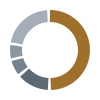
Priced value that passes: 0.0%. Fails: 99.0%. Unknown or unclassified: 1.0%.
| Issuer | Structure | Rights test | Priced tokens | Tickers read | Value | Passes |
|---|---|---|---|---|---|---|
| xStocks | debt-linked note | fails | 36 | 12 | $595M | 0.0% |
| Ondo | debt-linked note | fails | 83 | 11 | $545M | 0.0% |
| bStocks | custodied entitlement | fails | 20 | 3 | $266M | 0.0% |
| Robinhood | debt-linked note | fails | 32 | 6 | $86.5M | 0.0% |
| Backpack | unclassified | unclassified | 11 | 0 | $15.6M | 0.0% |
| rStock | unknown | fails | 3 | 2 | $546K | 0.0% |
“Tickers read” is how many of the issuer’s tokens are named in the registry row by row; the rest are attributed from the programme, because a structured note is a structured note whichever stock it tracks. The verdict is from the issuer document linked on every registry row; “unknown” means the document did not state an element: Dinari’s page says only that a dShare is backed 1:1 by a security, and Coinbase’s says dividends are reinvested and voting is for vested holders only, and neither states the claim in liquidation. It is never rounded to a guess. bStocks are ADGM certificates representing an interest in shares the issuer holds, “not direct ownership”, so they fail without being debt.
Four markets, one company, no shared oracle
Correction, 28 July 2026. This section used to be headed “Price where none exists” and opened “SpaceX is private. There is no NYSE quote.” SpaceX listed on Nasdaq as SPCX on 12 June 2026, and that claim was wrong here for six weeks. It is corrected rather than deleted.
What is still true, and still measured, is the agreement itself:
| Issuer | Ticker | Price | 24h volume | Deviation | Verdict |
|---|---|---|---|---|---|
| bStocks | SPCXB | $149 | $29.8M | -0.01% | ok |
| xStocks | SPCXX | $149 | $24.8M | -0.15% | ok |
| Robinhood | SPCX | $149 | $17.8M | 0.07% | ok |
| Backpack | SPCX | $149 | $8.5M | 0.00% | ok |
| Ondo | SPCXON | $150 | $2.4M | 0.21% | ok |
Independent order books, no shared oracle between them, pricing the same company within cents of each other. That is a real finding about how tokenized equity markets behave, and it does not depend on the underlying being private. The open question about SpaceX resolved the dull way: these markets priced it near $110 while the IPO priced at $135, and the share has since traded down to the tokens’ level. The gap was a current price compared against a historical one, the same class of mistake as comparing a single-chain supply to a multi-chain total.
Premium against the real share: withdrawn
This page used to publish a premium for every tokenized stock against the real listed share. It was removed on 31 July 2026 because it was wrong, and the way it was wrong is worth stating rather than quietly deleting.
The reference was stale and the guard did not catch it. Every row compared a live 24/7 token quote against a stock close from up to 37.8 hours earlier. The staleness ceiling was set at 96 hours, so all 183 rows passed while the equity feed sat at one successful run against hourly token prices. Bloom Energy published +35.04%. Eleven boards read above +14% at once. None of it was a premium; it was a full trading session of ordinary movement charged to the tokens.
And some token quotes are simply wrong. After refreshing the reference to 13.8 hours the worst case barely moved: one tokenized CrowdStrike still read a 300% premium, quoting about $741 against a real share near $179. That is not staleness, it is a bad price, and no reference age fixes it.
The honest version of this comparison needs an equity price sampled close to when the token was quoted. A daily close cannot do it, because the whole point of these instruments is that they trade while the exchange is shut. Blue Ocean ATS covers 20:00 to 04:00 ET and is the obvious input; the weekend remains genuinely uncovered by any US venue. Until then there is no premium column.
Does the 24/7 market know where the stock opens?
This is the strongest claim made for tokenized equities: the exchange shuts, the token keeps trading, so the token should tell you tomorrow’s price. We measure it rather than repeat it, and the first version of this section got it wrong.
We were scoring against the wrong price. A quote taken at 2am ET is predicting the opening bell, not 4pm. Measured against the close, the token looked useless and this page concluded it was “pinned near the prior close rather than discovering a price”. Measured against the open, the median realized move is 1.01x what the token implied. It sizes overnight gaps nearly correctly. Against the close the same quotes give 2.00x, and that gap is not a failure of the token: it is the trading session the token could not have known about.
We still will not give you a hit rate. Against the open the direction is right on 93 of 98 name-days, which looks spectacular and is not evidence. On each day measured, 85 to 96% of the tokenized signals pointed the same way and 74 to 96% of the opens did too, because both are dominated by one market-wide overnight move. That is three independent observations, not 98. The magnitude numbers above need no such assumption, which is why they are the ones published.
And one more limit, because it is the one a professional would raise first. US stocks already trade overnight on Blue Ocean ATS, 20:00 to 04:00 ET Sunday through Thursday, since 2021. Every snapshot behind the numbers above but one was taken inside those hours, so a conventional US venue was pricing the same share at the same moment and the token may be tracking it rather than discovering anything. Split by whether any US venue was open, the weekend observation sizes the gap at 1.03x and the Blue Ocean-overlapping ones at 1.25x, but that is one day against two. The hours genuinely nothing else covers are Friday 20:00 to Sunday 20:00 ET, and that is where this dataset can say something no other source can.
Which version should you hold?
Prices are held together by arbitrage against redemption, not by an oracle. If a token drifts above the real share you buy the share, mint the token, and sell it. So a token’s distance from its peers is a readout of whether that issuer’s redemption actually works.
| Stock | Name | Type | Issuers | Liquid | 24h volume | Worst spread | Problems |
|---|---|---|---|---|---|---|---|
| NVDA | NVIDIA | equity | 6 | 4 | $129M | 19.9% | 2 |
| SPCX | SpaceX | equity | 5 | 5 | $83.4M | 0.2% | 0 |
| SNDK | Sandisk | equity | 5 | 4 | $28.0M | 0.1% | 0 |
| META | Meta Platforms | equity | 4 | 4 | $23.0M | 0.2% | 0 |
| GOOGL | Alphabet Class A | equity | 4 | 4 | $19.1M | 0.1% | 0 |
| TSLA | Tesla | equity | 5 | 4 | $16.1M | 84.9% | 1 |
| SPY | SPDR S&P 500 ETF | etf | 3 | 2 | $14.1M | 10.0% | 1 |
| COIN | Coinbase Global | equity | 4 | 4 | $12.1M | 0.1% | 0 |
| CRCL | Circle Internet Group | equity | 3 | 3 | $11.9M | 0.1% | 0 |
| AAPL | Apple | equity | 3 | 3 | $8.8M | 0.2% | 0 |
| MU | Micron Technology | equity | 4 | 3 | $8.4M | 0.5% | 0 |
| RKLB | Rocket Lab | equity | 3 | 3 | $7.0M | 0.5% | 0 |
| MSFT | Microsoft | equity | 4 | 4 | $6.2M | 0.3% | 0 |
| AMZN | Amazon.com | equity | 3 | 3 | $5.3M | 0.1% | 0 |
| BABA | Alibaba Group | equity | 3 | 3 | $4.6M | 0.9% | 0 |
| MSTR | Strategy (formerly MicroStrategy) | equity | 3 | 3 | $4.4M | 0.1% | 0 |
| GME | GameStop | equity | 3 | 3 | $4.4M | 1.1% | 0 |
| PLTR | Palantir Technologies | equity | 4 | 4 | $4.3M | 0.4% | 0 |
| COST | Costco | equity | 2 | 2 | $4.2M | 0.2% | 0 |
| AMD | Advanced Micro Devices | equity | 4 | 4 | $3.7M | 0.3% | 0 |
| AVGO | Broadcom | equity | 4 | 2 | $3.7M | 0.5% | 0 |
| MRVL | Marvell Technology | equity | 5 | 2 | $3.6M | 2.6% | 1 |
| QQQ | Invesco QQQ ETF | etf | 2 | 2 | $3.5M | 0.1% | 0 |
| LLY | Eli Lilly | equity | 3 | 2 | $3.1M | 0.2% | 0 |
| INTC | Intel | equity | 4 | 3 | $3.0M | 0.1% | 0 |
| GLW | Corning | equity | 3 | 2 | $2.8M | 0.9% | 1 |
| CRWV | CoreWeave | equity | 3 | 2 | $2.7M | 1.2% | 0 |
| HIMS | Hims & Hers Health | equity | 2 | 2 | $2.6M | 0.2% | 0 |
| BMNR | BitMine Immersion Technologies | equity | 2 | 1 | $2.2M | — | 0 |
| WDC | Western Digital | equity | 2 | 2 | $1.9M | 0.0% | 0 |
| IBM | IBM | equity | 2 | 1 | $1.8M | — | 0 |
| BE | Bloom Energy | equity | 2 | 2 | $1.8M | 0.1% | 0 |
| ASML | ASML Holding | equity | 2 | 1 | $1.7M | — | 0 |
| QCOM | Qualcomm | equity | 3 | 2 | $1.5M | 0.7% | 0 |
| HOOD | Robinhood Markets | equity | 2 | 2 | $1.4M | 0.1% | 0 |
| XOM | Exxon Mobil | equity | 2 | 1 | $1.3M | — | 0 |
| CVX | Chevron | equity | 2 | 1 | $1.2M | — | 0 |
| AAOI | Applied Optoelectronics | equity | 3 | 2 | $891K | 1.7% | 1 |
| AMAT | Applied Materials | equity | 2 | 1 | $886K | — | 0 |
| ADBE | Adobe | equity | 2 | 1 | $843K | — | 0 |
| ASTS | AST SpaceMobile | equity | 3 | 1 | $840K | — | 0 |
| QBTS | D-Wave Quantum | equity | 2 | 1 | $807K | — | 0 |
| ACN | Accenture | equity | 2 | 1 | $705K | — | 0 |
| MA | Mastercard | equity | 2 | 1 | $704K | — | 0 |
| BA | Boeing | equity | 2 | 2 | $692K | 0.1% | 0 |
| KO | Coca-Cola | equity | 2 | 1 | $641K | — | 0 |
| SBET | SharpLink Gaming | equity | 2 | 1 | $192K | — | 0 |
| APLD | Applied Digital | equity | 2 | 1 | $167K | — | 0 |
| CORZ | Core Scientific | equity | 2 | 1 | $153K | — | 0 |
| ABT | Abbott | equity | 2 | 1 | $121K | — | 0 |
| ABBV | AbbVie | equity | 2 | 0 | $19K | — | 0 |
| CRWD | CrowdStrike | equity | 2 | 0 | $5K | — | 0 |
| APP | AppLovin | equity | 2 | 0 | $2K | — | 0 |
Issuers to avoid
Two independent failures at once: no meaningful volume and a price adrift from peers. An issuer can wash trade its own token, but it cannot make competitors agree with a wrong price, so failing both is a strong signal.
| Stock | Issuer | Ticker | Price | Peers say | Off by | 24h volume |
|---|---|---|---|---|---|---|
| TSLA | rStock | TSLAR | $54 | $354 | -84.9% | $3 |
| NVDA | rStock | NVDAR | $183 | $228 | -19.9% | $20 |
| SPY | rStock | SPYR | $695 | $771 | -10.0% | $1 |
| NVDA | Backpack | NVDA | $222 | $228 | -2.7% | $501 |
| MRVL | Backpack | MRVL | $268 | $262 | 2.6% | $22,266 |
| AAOI | Robinhood | AAOI | $98 | $100 | -1.7% | $100 |
| GLW | Robinhood | GLW | $160 | $158 | 0.9% | $23 |
Qualified liquidity
Every liquidity figure on these pages is a qualified figure: the sum of pools that pass a stated test, applied per pool, with the excluded amount published beside it so the derivation is checkable.
The test is a plausibility ceiling rather than a size floor. A pool claiming more than 10x the market capitalisation of the token it holds does not qualify, because a pool cannot hold ten times as much of a token as exists.
| Network | All pools | Qualified | Excluded | Excluded % | Pools excluded |
|---|---|---|---|---|---|
| bsc | $1,157,116,448 | $40,976,353 | $1,116,140,095 | 96.5% | 1 |
| robinhood | $288,146,007 | $265,615,648 | $22,530,359 | 7.8% | 1 |
| solana | $59,740,779 | $59,740,779 | $0 | 0.0% | 0 |
| eth | $4,246,654 | $4,246,654 | $0 | 0.0% | 0 |
| hyperevm | $7 | $7 | $0 | 0.0% | 0 |
| arbitrum | $0 | $0 | $0 | 0.0% | 0 |
On Robinhood Chain, when this was first measured, all pools together came to $2.97 billion and the qualified
figure was $33 million. One pool was the entire difference, and its own numbers are what the test reads: it
claimed 508.7x the market capitalisation of the token it held, had recorded zero trades in 24 hours, and
quoted NVDA at $2.87 against a real closing price near $197. The nvda in that pool’s name is not NVIDIA. It
is a token named to resemble it, which is why every comparison here matches pools by contract address and
never by pool name.
Where the 10x came from
A threshold picked for looking round is not a standard, so this one was calibrated against the data and against its own failure mode. Market capitalisation is not a hard bound in practice: it is derived from circulating supply, which is routinely understated for small tokenized wrappers, so pools that are entirely honest still land at 1.5x to 3x. A ceiling set at 1x flagged three pools and one of them was real, an actively traded market turning over $86.7M in 24 hours, and would have deleted $2.37M of genuine depth from the published figure. So 10x sits well above the honest range and well below what the failing pool claims. The choice is deliberately reluctant in one direction: excluding real liquidity understates depth, and for anyone reading these figures as tradeable that is the more damaging error.
Where these actually trade
A token existing on a chain tells you nothing about whether it trades there. A dead pool is worse than uninteresting: its stale price still gets quoted. One such pool priced NVIDIA at $1,180 against a real $208, a 467% premium on zero volume.
| Chain | Tokens | Active | Ghost | Pools | Dead pools % | Liquidity | 24h volume |
|---|---|---|---|---|---|---|---|
| robinhood | 27 | 16 | 11 | 5,993 | 98.3 | $266M | $123M |
| solana | 69 | 18 | 51 | 3,762 | 98.6 | $59.7M | $139M |
| bsc | 91 | 8 | 83 | 2,449 | 98.9 | $41.0M | $50.4M |
| eth | 77 | 1 | 76 | 927 | 99.9 | $4.2M | $1.4M |
| hyperevm | 3 | 0 | 3 | 3 | 100.0 | $7 | $1 |
| arbitrum | 1 | 0 | 1 | 1 | 100.0 | $0 | $0 |
They exist everywhere and trade almost nowhere.
Ghost listings
Deployed, quotable, and with no live venue at all:
| Token | Issuer | Chain | Pools | Liquidity | 24h volume |
|---|---|---|---|---|---|
| Alibaba • Robinhood Token | Robinhood | robinhood | 244 | $1,432,244 | $147,788 |
| NVIDIA (Ondo Tokenized Stock) | Ondo | bsc | 143 | $169,835 | $3,374 |
| Tesla (Ondo Tokenized Stock) | Ondo | eth | 135 | $1,423,350 | $23,249 |
| Marvell Technology • Robinhood Token | Robinhood | robinhood | 123 | $707,007 | $1,669 |
| SPDR S&P 500 ETF (Ondo Tokenized ETF) | Ondo | eth | 98 | $380,467 | $44,470 |
| ASML Holding NV • Robinhood Token | Robinhood | robinhood | 81 | $868,454 | $6,775 |
| AST SpaceMobile • Robinhood Token | Robinhood | robinhood | 57 | $179,870 | $68 |
| SpaceX xStock | xStocks | eth | 54 | $110,173 | $783 |
| Broadcom • Robinhood Token | Robinhood | robinhood | 47 | $275,108 | $28,556 |
| Applied Optoelectronics • Robinhood Token | Robinhood | robinhood | 45 | $141,874 | $268 |
| SPDR S&P 500 ETF (Ondo Tokenized ETF) | Ondo | bsc | 41 | $42,650 | $35 |
| Invesco QQQ ETF (Ondo Tokenized ETF) | Ondo | bsc | 40 | $39,658 | $286 |
Showing 12 of 225.
How this is judged
A venue counts as live only if it moved at least $10K in 24 hours and holds at least $100K of liquidity. Both thresholds are configuration, recorded on every row, so any number here can be traced to the floor that produced it. Raised on 28 July 2026, from $100 and $1,000. Those were not a floor: $100 of daily volume is noise, and $1,000 of depth means a $500 order moves the price against you. The new pair is the honest reading of “a retail-size trade clears here”. It cut the live count from 44 to 23, which makes the finding stronger, not weaker. Participant counts are used rather than trade counts; one pool showed 657 transactions from 8 addresses, which counting trades would have called a busy market.
The full per-token venue table is on the audit console. See the methodology for the rest of the assumptions.